
BENDS & ELBOWS PRODUCT OVERVIEW
Premium piping elbows and induction bends engineered to optimize directional changes, minimize pressure losses, and ensure long-term mechanical integrity of pipeline systems under severe service conditions.
1. PRODUCT RANGE
High-Precision Directional Fittings
• Standard Piping Elbows
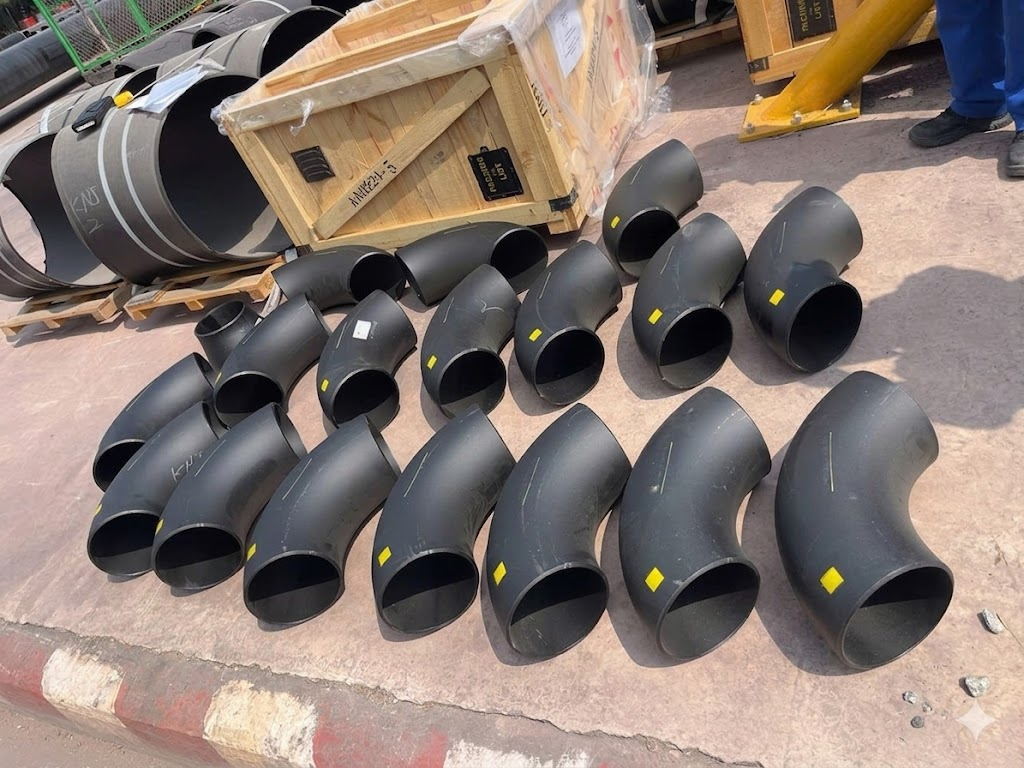
Full range of factory-formed butt-weld elbows available in 45°, 90°, and 180° configurations, produced in both Short Radius (1D) and Long Radius (1.5D) geometries for optimized piping layout flexibility.
• High-Frequency Induction Bends
Specialized hot induction bending solutions for mainline pipelines requiring smooth directional transitions.
Available in large-radius configurations such as 3D, 5D, 7D, 10D and above, with customized bend angles ranging from 1° to 180° according to project design requirements.
• Dimensional Capabilities
Nominal pipe sizes from 1/2″ up to 60″ NPS, with wall thickness schedules from Sch 10S to Extra-Extra Strong (XXS), including project-specific heavy-wall designs.
• Wall Thinning Compensation Design
For induction bends, mother pipes are carefully selected with additional wall thickness allowances to compensate for material thinning at the extrados during bending, ensuring full compliance with design codes after forming.
COMPREHENSIVE MATERIAL MATRIX
• Carbon & Low-Temperature Steel
ASTM A234 WPB and ASTM A420 WPL6 for general and cryogenic piping applications.
• Corrosion-Resistant Alloys (CRA)
ASTM A403 WP316/L stainless steel, along with Monel and Inconel alloys for highly corrosive and chemically aggressive environments.
• High-Temperature Alloy Steel
ASTM A234 WP5, WP11, WP22, and WP91 for high-pressure steam lines, refinery units, and thermal processing systems.
2. TECHNICAL CAPABILITIES & QUALITY ASSURANCE
Stress Mapping via Finite Element Analysis (FEA)
- For large-radius induction bends operating under cyclic loading or high-pressure gas transmission systems, TATIS performs detailed Finite Element Analysis (FEA) to evaluate stress distribution and structural behavior.
- This ensures control of residual stress, long-term fatigue resistance, and safe performance under hydrostatic testing and real operating conditions.
Dimensional Tolerance & Ovality Control
- All induction bending processes are executed using computer-controlled induction bending machines for high precision and repeatability.
- Post-bend wall thickness, ovality, and geometric tolerances are strictly controlled in compliance with ASME B16.49 requirements.
Hydrostatic Pressure Testing
- 100% of components supplied for severe-service applications are subjected to hydrostatic pressure testing as per applicable project specifications.
- This ensures zero-leakage performance and verifies structural integrity beyond standard operating pressure limits.
Supply Chain Auditing & Third-Party Certification
- Mother pipes are sourced exclusively from internationally approved steel mills listed in major operator AVL (Approved Vendor List).
- Post-bending heat treatment processes (normalizing, stress relieving, quenching & tempering) and all NDT inspections are fully witnessed and certified by independent third-party inspection agencies including DNV, Bureau Veritas, and Lloyd’s Register.